
Managing Incoming Parcels in an Office Environment
Where Parcel Management Actually Starts to Fail
On paper, the process is simple: receive, log, store, notify, hand over. In practice, it starts to break down the moment volume increases.
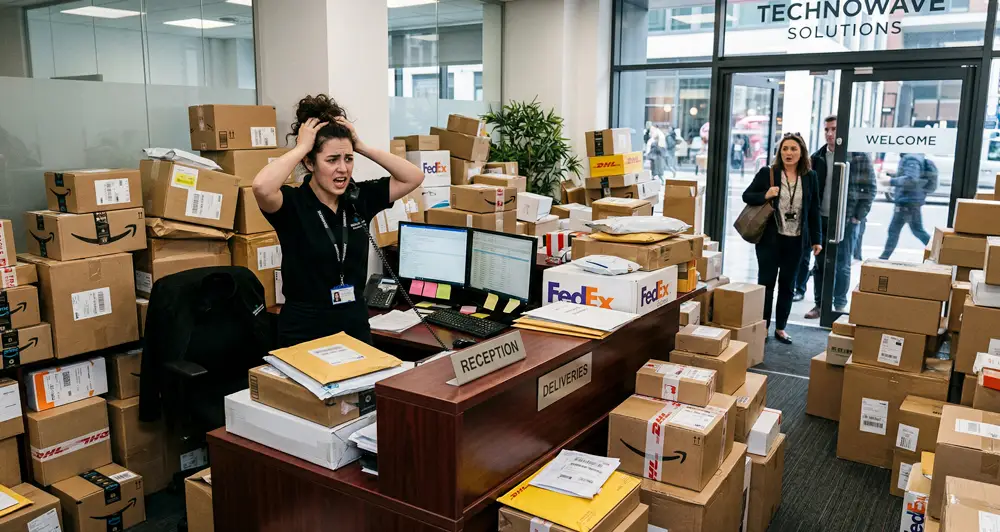
Reception teams are rarely dedicated logistics staff. They’re handling visitors, calls, security, and internal queries at the same time deliveries are arriving. Logging becomes inconsistent. Parcels are placed in temporary holding areas. Notifications are delayed or forgotten altogether. The timing makes it worse than it sounds, because arrivals are not spread evenly across the day: across 224,604 parcels we measured, 49% had arrived by 2pm and 1pm alone accounted for 16.6% of the day. Cover is usually spread evenly. The deliveries are not.
At that point, small inefficiencies compound quickly:
- Items are recorded late or not at all
- Parcels are moved without being tracked
- Staff interrupt reception repeatedly to check for deliveries
- When something goes missing, there’s no clear record of what happened
This is where organisations begin to realise they don’t have a people problem, they have a visibility problem, and without visibility, there is no control.
Why Manual Tracking Doesn’t Scale
Many offices still rely on spreadsheets, paper logs, or informal processes to manage deliveries. These can work at low volumes, but they don’t survive growth.
The issue isn’t just speed, it’s reliability.
Manual systems depend on consistency under pressure. They assume that every parcel will be logged at the right time, in the right place, by the right person. In reality, that consistency breaks down quickly in busy environments.
More importantly, manual tracking creates gaps:
- There’s no real-time view of what has arrived
- No reliable way to locate a parcel once it’s been moved
- No proof of who collected it
This is exactly why organisations move towards parcel tracking software - not as a convenience, but as an operational requirement.
What a Controlled Parcel Intake Process Looks Like
When parcel management is working properly, it doesn’t feel chaotic. It feels predictable. Deliveries are processed quickly, but not loosely. Every item is accounted for from the moment it enters the building.
Typically, that looks like this:
A parcel arrives and is immediately scanned, not just signed for. That single action creates a record time, date, courier, and recipient without relying on memory or manual entry. From there, the system takes over. The recipient is notified automatically. The parcel is stored in a known, trackable location. When it’s collected, that handover is recorded, creating a complete audit trail.
Nothing complicated, just consistent. This is the foundation of a proper internal parcel tracking system and it’s where most organisations see the biggest shift in control.
The Difference Visibility Makes
The moment you introduce structured tracking, the dynamic changes.
Reception teams stop being interrupted constantly because staff no longer need to ask if something has arrived. They already know. Parcels don’t sit uncollected for days because notifications happen immediately. And when something does go wrong, which still happens occasionally, there is a clear record to refer back to. No guesswork, no finger-pointing.
This is why even relatively small organisations are now adopting mailroom management software . Not because they have a formal “mailroom,” but because the operational demands are the same.
It’s Not Just About Efficiency
Most people initially look at parcel management as an efficiency issue. In reality, it’s also about accountability and risk. In sectors like healthcare, logistics, or regulated environments, parcels aren’t just office supplies. They can be sensitive items, high-value equipment, or time-critical deliveries. Losing visibility isn’t just inconvenient, it can have real consequences.
Without a proper system:
- there is no audit trail
- there is no proof of delivery
- there is no defensible process
That’s where a structured package tracking system becomes essential, not optional.
Why This Problem Is Getting Worse, Not Better
Parcel volumes aren’t stabilising, they’re increasing. More direct-to-office deliveries, more decentralised teams, more reliance on courier networks. All of this puts pressure on processes that were originally designed for a different era. At the same time, expectations have changed. Staff expect instant notifications. Organisations expect traceability. Operations teams are expected to do more with less resource. The gap between what’s required and what manual processes can deliver is only getting wider.
Taking Back Control of Incoming Deliveries
Fixing parcel management doesn’t require a complex transformation. It requires the right system underpinning a simple process.
Once every delivery is logged, tracked, and accounted for from arrival to collection, the chaos disappears surprisingly quickly.
Reception becomes calmer. Staff stop chasing. Lost items become rare rather than routine.
Most importantly, the organisation regains control over something that, until then, has been largely invisible.
A modern delivery tracking system for businesses provides that control in a way manual processes simply can’t.
See How It Works in Practice
If your current process relies on spreadsheets, paper logs, or informal tracking, you’re already experiencing the limitations. The same problem seen from the building’s side is covered in office parcel tracking.
The difference with a dedicated system is not theoretical - it’s immediate and visible.
Book a demo to see how incoming parcel management works when it’s properly structured.
Try Traizr For Free
Fast and secure internal mail tracking with real-time alerts, QR-code pickups, and full audit trails.

Join the Traizr Network
Thousands of professionals rely on Traizr for secure, auditable internal delivery workflows. Follow us for news, guides, and updates.