The Problem with Relying on Courier Tracking
Courier systems are built to solve a different problem. They track parcels across networks, between depots, and up to the point of delivery.
They are not designed to tell you what happens next.
A delivery status might confirm that something has been signed for, but it does not tell you who actually received it, where it was placed, or whether it has been collected. From an operational point of view, that information is far more important than the journey it took to get there.
This creates a blind spot inside the organisation. Everything before delivery is visible. Everything after is largely untracked.
For businesses handling a steady flow of deliveries, that blind spot becomes increasingly difficult to manage.
What Internal Tracking Actually Changes
Introducing internal tracking does not add complexity. It removes uncertainty.
Instead of parcels entering the building and effectively disappearing into an informal process, each item becomes part of a structured flow.
The key difference is that tracking does not stop at the door. It continues through every stage of handling.
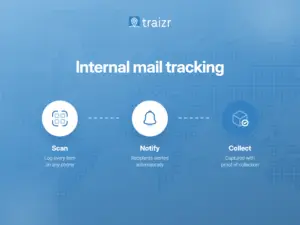
A parcel is logged as it arrives. It is associated with a recipient. Its location is known. When it moves, that movement is recorded. When it is handed over, there is a clear record of who collected it and when.
This creates continuity. At no point is the parcel “unaccounted for.”
That level of control is what defines a proper package tracking software for offices
Where Internal Processes Typically Break Down
In organisations without internal tracking, the same weak points appear again and again.
Reception signs for deliveries quickly, often without capturing meaningful detail. Parcels are placed in temporary locations that are not formally recorded. Items are moved to make space, but the movement is not tracked. Collection is informal, with no confirmation beyond a verbal exchange.
Individually, these actions seem harmless. Together, they create gaps large enough for parcels to be misplaced without anyone noticing immediately.
By the time a query is raised, the trail has already gone cold.
This is why attempts to “tighten process” without changing the underlying system tend to fail. The problem is not a lack of rules. It is a lack of visibility.
The Role of Scanning, Not Just Logging
One of the biggest shifts in internal tracking is the move away from manual logging towards scanning.
When parcels are recorded manually, accuracy depends on speed, attention, and consistency. Under pressure, those conditions are rarely met.
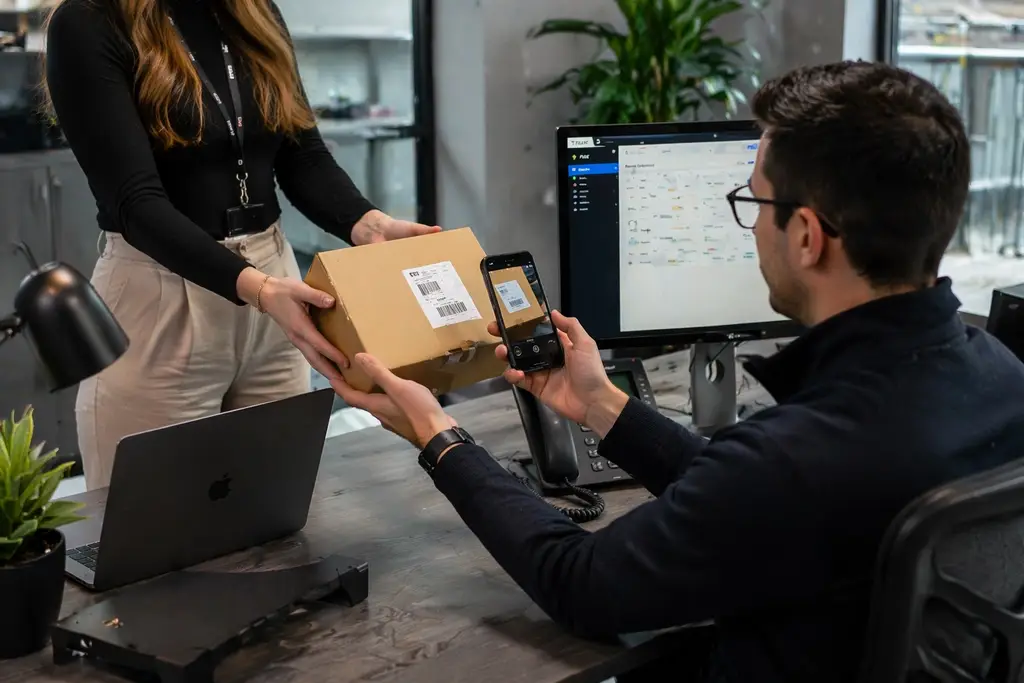
Scanning changes that dynamic. A barcode or label is captured instantly, creating a reliable record without interrupting the flow of work. Time, date, and handler are recorded automatically, removing ambiguity.
From that point on, the system maintains the record. Notifications can be triggered, locations can be assigned, and collection can be verified without relying on additional manual steps.
This is a core component of modern mailroom tracking systems, and it is often where organisations see the most immediate improvement.
Why Visibility Matters More Than Speed
In many environments, the instinct is to prioritise speed. Get parcels signed for, get them off the desk, keep things moving.
The issue is that speed without visibility creates problems downstream.
A parcel processed quickly but without a proper record is effectively untracked. Any time saved at intake is lost many times over when someone has to search for the item later.
When tracking is structured properly, speed and visibility are not in conflict. Parcels can be processed quickly because the system captures the necessary information automatically.
This is why organisations implementing an internal parcel tracking system often find that both efficiency and control improve at the same time.
Where Internal Tracking Becomes Critical
The need for internal tracking increases with scale and complexity.
In large office environments, parcel volume alone creates risk. In healthcare settings, the nature of the deliveries raises the stakes. In universities and multi-site organisations, the challenge is compounded by distribution across locations.
In all of these cases, the same principle applies. Once a parcel is inside the organisation, it must remain visible.
Without that visibility, processes become reactive. Staff spend time searching, chasing, and resolving issues that could have been prevented.
With it, parcel handling becomes predictable and controlled.
From Uncertainty to Accountability
One of the less obvious benefits of internal tracking is accountability.
When every interaction with a parcel is recorded, responsibility is no longer ambiguous. It is clear who received an item, where it was stored, and who collected it. This does not create friction. It removes it.
Disputes are resolved quickly because there is a record to refer to. Staff confidence improves because the process is reliable. Reception teams are no longer placed in the position of having to answer questions without information.
This is the difference between a process that depends on individuals and one that is supported by a system.
Building a Complete Delivery Record
At its core, internal tracking is about continuity.
A parcel should not have one record for its journey through the courier network and another, incomplete record once it enters the organisation. It should have a single, continuous history from dispatch to final handover. Where an item moves on again after that first handover, multi-hop mail routing keeps that history unbroken across every leg.
A well-implemented delivery tracking system for businesses provides that continuity. It ensures that no stage of the process is invisible.
For organisations that rely on deliveries as part of their day-to-day operations, that level of visibility is no longer optional. It is a fundamental requirement.
See Internal Tracking in Practice
If your current process relies on manual logging or informal handling, the limitations will already be clear. Parcels are harder to locate than they should be, and resolving issues takes longer than it should.
The difference with a structured system is immediate. Every parcel is accounted for, and every step is visible.
Book a demo to see how internal parcel tracking works in a real operational environment.